

06 Apr Why We Decided to Write The Power of GEO
(…and what is changing in digital positioning)
Some time ago, we started noticing something we couldn’t fully explain. After years working on digital positioning, we had built a system that, with effort, functioned in a reasonably stable way. And yet, it stopped doing so.
In our case, this translated into a significant drop in traffic that couldn’t be explained by any isolated adjustment. For a while, we looked for answers within the system itself. But the more we analyzed what was happening, the clearer it became that the issue wasn’t there. It wasn’t a problem of execution—it was a problem of how we understood the system.
When the system changes, the rules change
What began to shift was not just performance, but the logic that explained it.
For years, digital positioning was based on search engines that organized information, and SEO made sense within that context.
However, we are now facing a shift in how information is accessed. More and more users prefer to ask rather than search. And when someone asks an AI system a question, they don’t compare options—they delegate the answer.
This introduces a structural difference. The challenge is no longer about being in the list, but about being the option selected within the answer. It’s no longer just about visibility—it’s about defensibility.
Trying to understand the system from within
At that point, we shifted our approach in order to better understand what was happening.
We began interacting systematically with different AI systems to observe how they were making decisions. We asked them directly about this shift, about their role as new information intermediaries, and, most importantly, about something very specific: how a small or medium-sized business, with limited resources, could position itself in this new environment.
The answers were not definitive, but they started to point in a common direction.
Two concepts kept appearing—ones we were already familiar with, but had not considered so decisive: authority and reputation.
From internal notes to an initial framework
We documented everything along the way.
At first, not with the intention of publishing anything, but as a way to organize what we were learning—for Kleinson, for ourselves, and for the team. In practice, it became a kind of internal manual that helped us make more informed decisions.
We weren’t trying to build a narrative. We were trying to better understand the system.
And yet, that process began to take shape.
The decision to write the book
It was at that point that Gonzalo reviewed the material and raised an important question. What we were seeing was not only useful for us—it reflected a broader problem faced by many small businesses, professionals, and teams who were watching the rules change without a clear guide.
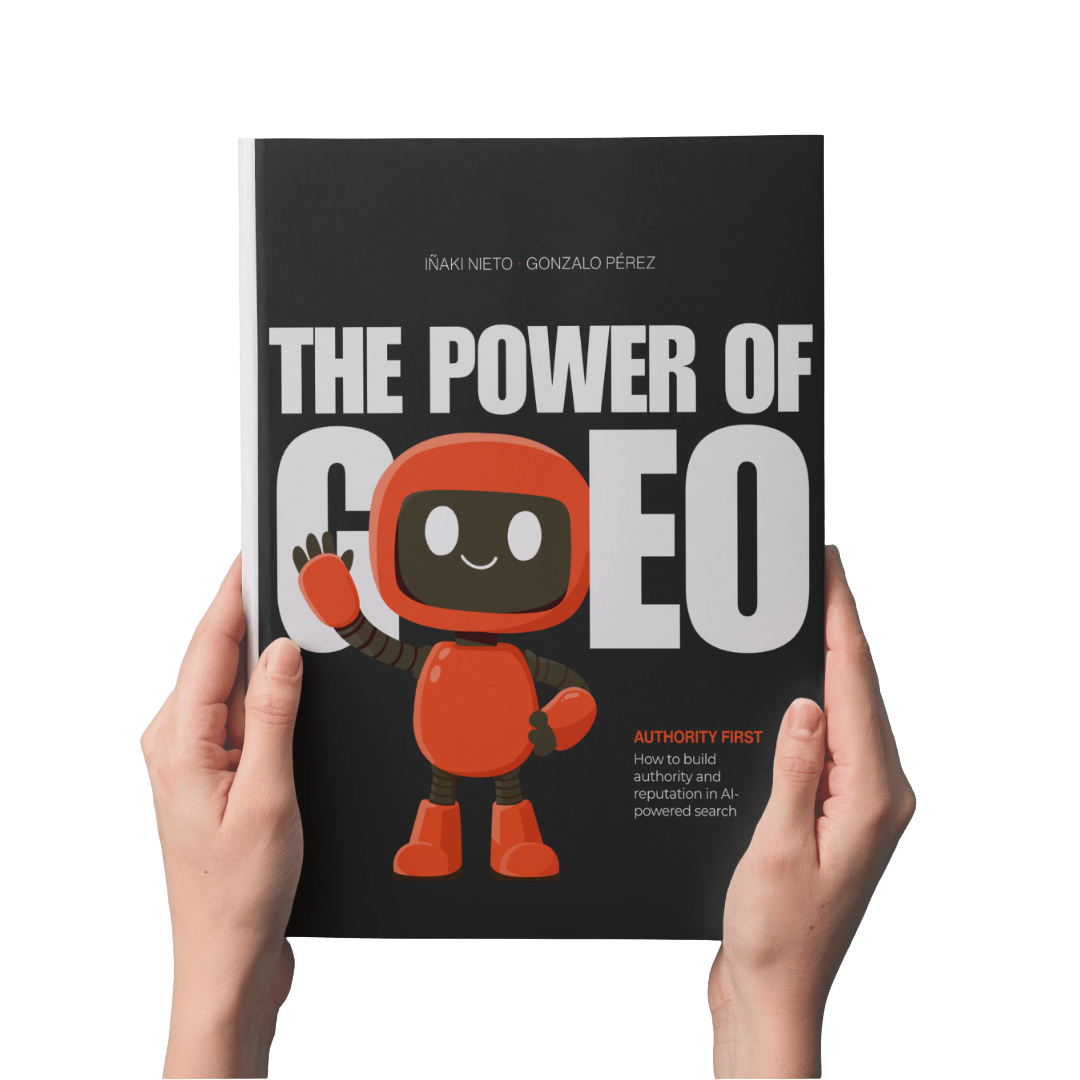
From there came the decision to write The Power of GEO, to give structure to an experience that could be useful to others.
Writing without starting from a position of expertise
The book is not written from the perspective of an expert. In fact, it starts from the opposite premise.
It is written from the position of someone trying to understand a shift while living through it.
This introduces an obvious tension. If authority is something that must be built, does it make sense to write about something you are still figuring out?
We chose to embrace that tension as part of the process.
Because, in a way, writing the book was also part of the experiment.
If what we were understanding was correct, we should be able to build positioning through that very process. And if it wasn’t, the learning would still be valuable.
The book as a consequence, not a starting point
From that perspective, The Power of GEO is not a manual or a closed methodology. It is not a resource book—it is an attempt to offer clarity.
The distinction matters. Tools operate within a system; clarity helps you understand the system before acting within it.
The book aims to organize what is changing, what seems to remain, and what is starting to make sense in this new context.
It is less about providing answers and more about learning how to ask better questions.
Authority and reputation as the foundation
One of the clearest insights from this process is that positioning in generative systems does not depend on what you say about yourself, but on how you are interpreted within a broader context.
Authority is not declared—it is inferred. And reputation depends on external signals.
From that perspective, visibility stops being the starting point and becomes a consequence.
Without one, the other remains incomplete.
A visible consequence
This process also explains the changes we have made in how we communicate over the past months, both at Kleinson and in our personal profiles.
They stem from the need to adapt to a system we are still learning to understand.
An open question
The change has already happened. The question is not whether it will arrive, but whether we are interpreting it correctly.
Because, as with any shift in systems, what we need is a framework from which to make decisions.
And the real question is whether we are prepared to operate within that new framework.
👉 The Power of GEO is available here: https://amzn.eu/d/0djCqdFt
Frequently Asked Questions on GEO and Digital Visibility
What is GEO (Generative Engine Optimization)?
GEO is a way of understanding positioning in an environment where answers are no longer limited to a list of links. It focuses on how content is interpreted, selected, and used by AI systems to generate responses.
Why is SEO no longer enough on its own?
SEO remains important, but it was designed for a search engine-based model. As users increasingly interact with systems that generate direct answers, new factors come into play that traditional SEO does not fully address.
How is AI changing the way people search for information?
AI enables a shift from searching to asking. Instead of navigating multiple results, users receive structured answers from the start, changing both the journey and how content is accessed.
What does authority mean in this new context?
Authority no longer depends only on what a website claims about itself, but on how it is perceived within a broader information ecosystem. It is built through signals coming from multiple sources and contexts.
Can small businesses compete in this new environment?
Yes, but it requires a different approach. Rather than focusing only on volume or isolated optimization, it becomes key to build a consistent, recognizable presence over time.